Standard
Solo / small firm$550/ case
- Evidence summary PDF
- Structured FHIR export
- HIPAA + BAA
- Wearable analysis
- Impact Check-Ins
Continuously document pain, functional limitations, and quality-of-life impact throughout the life of a case.
Your data. Your evidence.
The medical records document the injury. The MyWellnessID app documents its ongoing impact.
Twice-weekly Impact Check-Ins adapt to your client’s specific injury cervical, orthopedic, TBI, soft tissue. Photos, pain scores, and functional limitations are timestamped and structured for use in demand letters and at trial.
Every plaintiff can participate using only a smartphone. Wearables provide additional objective validation when available never required.
Beyond check-ins, plaintiffs attach their own supporting evidence straight from their phone every upload timestamped and preserved with the case file.
Disponible en inglés y español. Clients complete check-ins in the language they think and feel pain in, so your evidence stays accurate.
Twice-weekly Impact Check-Ins capture how your client is feeling in less than 90 seconds.
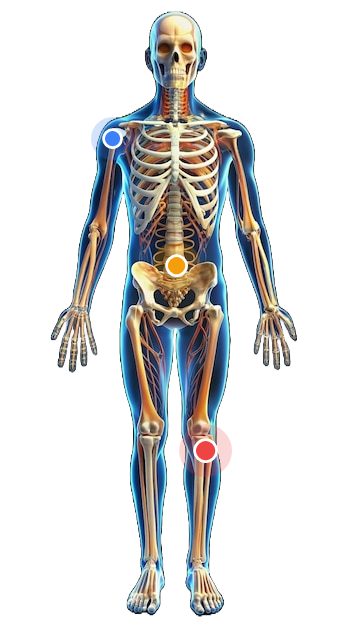
Clients identify pain locations on an easy to use body map. All entries are timestamped and saved as evidence.
Smart reminders help clients stay on track with appointments and treatment plans.
Clients stay informed every step of the way reducing the need for status calls.
Impact Check-Ins are the core engine of the platform. AI assists with structured questioning to continuously document how an injury affects your client’s life the plaintiff creates the content, the platform preserves it.
Adaptive questions capture pain intensity and location, timestamped on every check-in.
What the client can no longer do lifting, sitting, walking, working documented over time.
Awakenings and sleep-quality changes tracked as objective evidence of impact.
How the injury affects everyday routines, mobility, and independence.
Work, family, hobbies, and events the client could no longer participate in.
The full human cost of the injury, captured continuously for demand letters and trial.
Injury impact isn’t captured in a single moment it’s documented continuously, from intake all the way to settlement.
Documentation runs continuously from the first check-in through the life of the case not a one-time snapshot.
A timestamped trajectory of pain severity that shows how the injury evolved over weeks and months.
Concrete limitations lifting, sitting, working, sleeping recorded as objective, defensible evidence.
The everyday cost of the injury on routines, relationships, and quality of life, captured over time.
Record-analysis tools summarize what already happened on paper. MyWellnessID captures the severity story as it unfolds the part that actually moves a settlement.
Existing record tools Analyze records | MyWellnessID Documents injury impact | |
|---|---|---|
| Continuous severity tracking | ||
| Pain & suffering documentation | ||
| Functional limitation tracking | ||
| AI-assisted Impact Check-Ins | ||
| Quality-of-life impact documentation | ||
| Attorney-ready documentation package |
“Existing record tools” refers to traditional record-retrieval and record-summary software. Comparable scope assumed.
Every case ships with a Severity Documentation Package built for attorneys, expert witnesses, and adjusters, not plaintiffs. Drop it into your demand letter, or sync to your case management software in one click.
The plaintiff creates the factual content. The platform preserves and authenticates it. Every feature is designed to document not to determine medical, legal, or evidentiary conclusions.
Every plaintiff verifies their identity before any evidence is recorded, so each entry is attributable.
Each Impact Check-In and record is captured contemporaneously and locked with a timestamp.
A continuous, chronological record of the injury's impact from the date of incident onward.
A tamper-evident chain of custody travels with every document so its provenance can be shown.
A clear measure of how complete the documentation is never a judgment of legal merit or value.
One SMS or email link. Plaintiff verifies identity and authorizes records in under three minutes.
Medical records via FHIR R4 across 11+ EHR platforms. Wearable data syncs daily. Adaptive Impact Check-Ins run twice-weekly.
Evidence Completeness, Quantified Impact dashboard, exportable PDF + CSV. One-click sync to your case management system.
Pricing tiers subject to confirmation.
Every Check-In is built to answer the only question that matters when opposing counsel pushes back: “How do we know this happened?”
Every client verifies their identity before any Check-In is recorded.
Each entry is captured in real time and locked with a timestamp.
A complete, tamper-evident record of every action on the case file.
Every data point is traceable to its origin client, provider, or device.
Impact Check-Ins are cross-referenced against the underlying medical records.
Objective wearable data adds independent validation when available.
Medical records support the severity story. They do not tell the full impact of the injury so we pull them automatically and pair them with continuous severity documentation.
FHIR R4 across 11 EHR platforms covering 70%+ of US hospital and ambulatory care no faxes, no PDFs, no 8-week waits.
 1.png)










 Apple Health
 Fitbit
 Google Fit
Wearable data is optional supporting evidence. It adds independent, objective validation when a plaintiff already uses a device, and is never required to build a case.
Damages can’t be built without records. Most PI firms still wait weeks for them at the cost of cash flow, client trust, and settlement leverage.
Long record delays and poor communication during the wait strain the attorney–client relationship.
PI attorneys consistently cite medical record analysis as a major operational gap.
Depends on EHR + provider classification (Individual Access vs Treatment requests). Days to weeks. We surface status in real time.
We surface the status, the attorney gets a notification, and we provide a manual fallback request.
Major case management platforms used by PI firms. Contact us for the current integration roadmap.
No. It's a documentation tool only.
15 minutes. We’ll walk through one of your active cases and ship a sample Severity Documentation Package by Friday.